
To Protect Nature, I Had to Learn to Love It First

Article by TR Sammyukta, Nature Society Singapore Editorial Part-Timer
In a society increasingly lived through screens and camera lenses, you have probably seen plenty of social media posts about animals and nature, like a rare bird perched just long enough for someone to get the shot. A caption listing how few are left in the wild. A comment section full of people writing, “It’s so beautiful, hope it survives.”
It is easy to feel close to nature this way, because it is only ever a scroll away. Some people read on, some scroll past, and some think nature has nothing to do with them. But being a naturalist — someone who takes an active interest in nature — is not as fancy nor as easy as it sounds.
Take me for example: I’m a communications student with barely any experience in conservation. I’d known about the Straw-headed Bulbul (Pycnonotus zeylanicus) for months before I ever saw one in the wild. I’d researched about it, saved facts for an Instagram post for work purposes, and knew it was one of the most endangered songbirds in the world, long before I knew what it sounded like. I thought the bird was charming, even though I’d only ever “met” one through a screen.

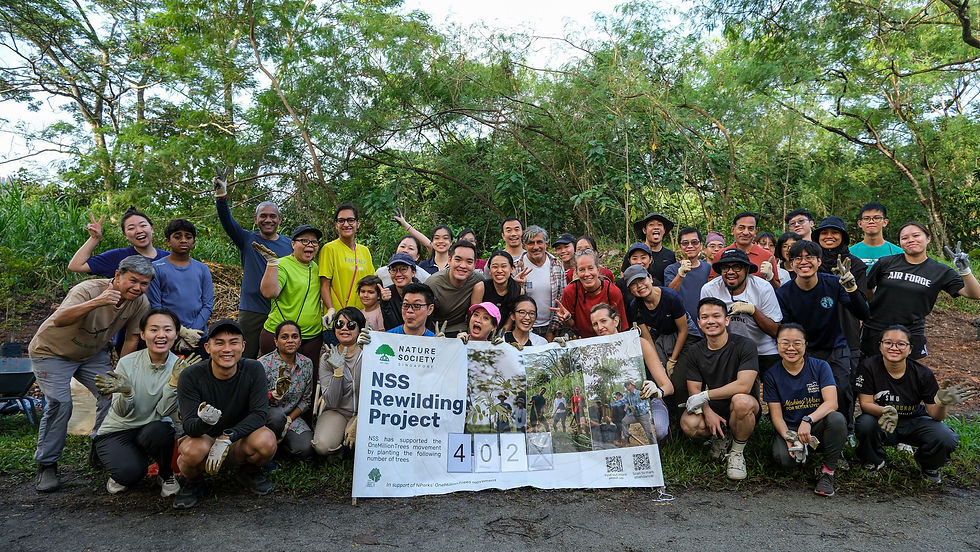
Then I went on a rewilding session along the Rail Corridor with my Nature Society colleagues and volunteers, and I found out how wrong I was.
My colleagues heard it before I did. Mid-sentence, one of them stopped, tilted her head, and said, that’s the Straw-headed Bulbul. I hadn’t registered a single sound. It took a beat before I caught what she was hearing: a bubbly call penetrating through the swaying trees. And then I saw it. Small, brown, a streak of yellow around the eye, nothing too dramatic.
I don't know how else to describe the experience other than that of pure joy.
I turned to my family the next day while on a walk and could not stop talking about the bulbul. I probably annoyed them a little. I then realised: this is what happens when you’ve felt the presence of nature. I was utterly marvelled by nature’s simple beauty, and I wanted everyone around me to feel it, too.
A globally endangered songbird, the Straw-headed Bulbul is highly sought after by songbird collectors and competitors. It has disappeared from much of its native range across Southeast Asia due to extensive poaching, to the extent that our tiny island nation is now home to about a third of its estimated global population — we have inadvertently become a refuge and stronghold for these birds.
I happened to cross paths with the bulbul on an ordinary Saturday morning. But anywhere else in the world, people would have to go to great lengths to see and hear this bubbly bird in the wild. I truly felt privileged to have seen this bird.
That the Straw-headed Bulbul is thriving here is thanks in large part to the strict wildlife protection laws and enforcement measures put in place by our authorities. But more can still be done, such as the efforts by Nature Society Singapore to raise public awareness of native wildlife, both endangered species and the more common animals we share our spaces with, alongside its tireless advocacy for conserving the wild spaces that are the habitats of these wonderful animals.
All the conservation statistics in the world wouldn’t have made me care about whether the Straw-headed Bulbul survives — but experiencing it, the marvel of its cheerful song, in Singapore’s proverbial “backyard” was what did. Only then did the bulbul become something “tangible” that I wanted to protect.
It also became something I wanted to share with people, the way you would tell people about something you love. The more we connect with and appreciate nature, the more we will want to protect what we have, and learn to live alongside it in harmony. We ought to have nature ingrained in our lives, so I urge you to “touch grass” (metaphorically), become a naturalist, and embrace our human nature to care for the people and things around us.
Sign up for a rewilding session with your family, go for a guided nature walk with your colleagues, or come join the annual Singapore Bird Race and leave with newfound friends. And when you do meet these animals along the way, remember that a little goes a long way: pause before reacting, keep a respectful distance, and let them go about their lives undisturbed. Come experience nature for yourself, because I believe we cannot love what we do not know, and we cannot know what we do not see, or hear, or sense.
Once you’ve experienced nature — like I have, in my own humble way — you’ll never take it for granted again.


Comments