
World Snake Day: MiSSSunderstood Creatures

Updated: Jul 16
Article by Kevin Yap, Volunteer with the Herpetological Society of Singapore
Common reactions that people have when they hear the word “snakes” are: “Such creepy creatures.”, “Will they attack me?”, or “They are so poisonous!!” While none of those statements are true, they stem from a lack of awareness about the true nature of snakes. This World Snake Day, the misconceptions of these misunderstood creatures will be addressed.
Our legless neighbours
There are 68 different species of snakes in Singapore that can be found across our forests and urban spaces. Out of these 68, only 7 are highly venomous; debunking the myth that all snakes are venomous. Although widespread and abundant, snakes are not easily sighted because they are generally shy and elusive, preferring to avoid human contact; debunking the myth that snakes are aggressive - they typically avoid confrontation and may only defend themselves when they feel threatened.
Snakes are also an integral part of the ecosystem; their presence is an indicator of a healthy ecosystem. They are our natural pest control, managing rodent and lizard populations.
A few species may be encountered on hikes or strolls in parks, but when they are found in residential areas, they are often portrayed in a negative light on social media. Here is some information about the most commonly encountered species for a better understanding of them and what to do when you encounter one.
Occasionally seen in residential areas: Reticulated Python (Malayopython reticulatus)

Our friendly neighbourhood rodent exterminator - the reticulated python is commonly found in residential areas for a few good reasons: The first being high prey density, where rodents make up over 70% of their diet.
The connectivity of our urban waterways, drainage systems, and park connectors are highly important to reticulated pythons as they use these to move safely between green spaces and urban areas. Scary as they may look, there have been only a handful of reported cases of human encounters in Singapore resulting in injuries. Yet, humans have caused several reported python fatalities due to irrational fear of these creatures.
Occasionally seen in urban parks: Oriental Whip Snake (Ahaetulla prasina)
If you have ever recalled seeing a slender, green snake on a tree, it was very likely an Oriental Whip Snake. These snakes are almost exclusively tree-dwelling, blending into the vegetation with their vine-like appearance. Their primary instinct when encountering humans is to stay still and rely on camouflage to avoid detection - looking just like a vine!

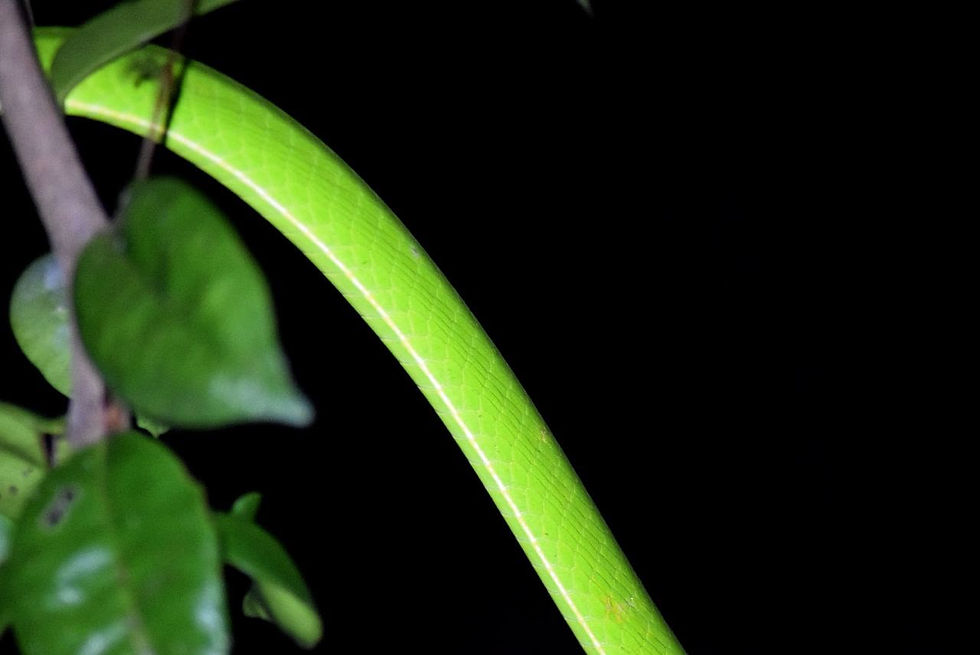
Although mildly venomous, the venom of this species does not have a strong adverse impact on humans, and they rarely bite unless provoked or disturbed — preferring to use their venom for capturing prey like lizards and birds.
Occasionally seen in nature parks and reserves: Wagler’s Pit Viper (Tropidolaemus wagleri)
The Wagler’s Pit Viper is definitely an eye-catching snake when sighted. Despite sporting visually striking colours and patterns, it still blends in with its habitat as an ambush predator. While highly venomous, these vipers are generally non-aggressive in nature and will not attack unprovoked. Thus, it is important to admire them from a safe distance.
A fun fact about the Wagler’s Pit Viper is that the males look like an entirely different species from females; a trait called sexual dimorphism. Although juvenile males and females look similar with a nuanced difference of spotted versus barred patterning respectively, females grow much larger and develop the black and greenish-yellow banded patterning as they mature into a full adult.


Now that you know more about some of our native snakes, there’s no reason to get hisssterical when you encounter them! But here is what you can do instead:
Observe the snake from a safe distance, especially if you are unsure if it is a venomous species. The Equatorial Spitting Cobra, a snake sometimes encountered in urban areas, is able to spit venom up to three metres away, aiming for the eyes of a perceived threat. Remember to use the zoom feature on your phones and cameras if you want a good picture.
Do not touch or take matters into your own hands. If you need to get a snake removed from an urban area, call professional wildlife rescue teams* to manage the situation. Improper handling may put you and the snake at risk of injury. Furthermore, harming wildlife is against the law under the Wildlife Act 1965, carrying a fine and a jail term.
Keep pets and small children away from the snake. Some snakes have mild venom that may have little effect on adults. However, the same may not be true for pets or young children. Keep your pets leashed and avoid any interaction with the snake.
*If a snake is in an urban area and would need to be relocated, you can get in contact with:
NParks Animal Response Centre: 1800-476-1600 (24-hours)
ACRES Wildlife Rescue: 9783 7782 (Available 7 am – 1 am)
For more information on snakes, feel free to check out OWN’s snake page and advisory.


For those who have used many wiki engines, the homepage is often the quickest way to spot what is different about a new one. This particular page does not try to reinvent the wheel but instead focuses on a clean presentation that makes the next step obvious. That can be a relief compared to platforms that assume you already know their ecosystem. If you are browsing for something straightforward, the wiki platform's entry view may be worth a look to see how it handles first impressions.
When the number of AI services grows each week, a page that groups them by task makes the first screening much easier. a category-organized tool directory can save time when you need to compare options without checking dozens of separate sites.
This collection focuses on a specific fantasy lineup with named characters and stage-inspired backgrounds. The artwork appears suited for older kids who enjoy more detailed scenes. Formats include A4 PDFs for printing and an online coloring option for digital use. Because the set is described as constantly updated, it may be worth a periodic visit. For a look at the latest additions, check the fantasy character sheet lineup.